The Abnihilisation
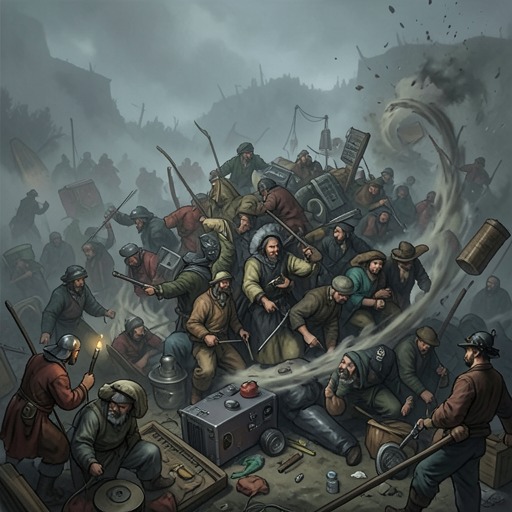
Finnegans WakeThe Abnihilisation is a world-spanning explosion rendered as a collision of sound, wreckage, and unstable matter. Its decisive force lies not only in the destruction it depicts but in the language that performs it: words splinter, recombine, and erupt alongside the imagined blast, so that catastrophe becomes both event and verbal upheaval.
The Explosion and Its Reach
The passage presents the Abnihilisation as a transformation of the etym into an explosive force, moving through a chain of grotesquely altered words before it detonates across Parsuralia. The blast is accompanied by a vast rumble and a confusion that seems to include everything within its reach. Rather than describing damage through a stable inventory of objects, the text makes matter itself unstable: tiny fragments and larger forms mingle in an image of scattered substance and bewildered scale.
The disturbance is not confined to Parsuralia. Comparable scenes are projected from Hullulullu, Bawlawayo, empyreal Raum, and mordern Atems. This quick succession of distant and fantastic place-names enlarges the explosion into a planetary spectacle, while the word “projectilised” makes the places seem less like passive settings than points from which the same violent scene is launched or reproduced. The event spreads by multiplication: the catastrophe is at once a particular blast and a pattern repeated across a world of shifting names.
Time, Light, and Disorientation
The explosion is fixed to an exact but uncanny instant: the passage identifies it as the twelves of clocks, noon minutes, none seconds. That measurement gives the scene a clocklike precision even as its language undoes ordinary temporal and spatial bearings. It culminates at a named seat of Oldanelang's Konguerrig, at dawn in Aira, setting noon-like clock time against daybreak. The contradiction does not resolve into a conventional chronology; instead, several kinds of time and place are made to coexist within the same explosive moment.
This collision of exact timing and impossible geography intensifies the scene's disorientation. The language supplies coordinates—clock, seat, dawn, and named regions—but each coordinate is warped by verbal invention. The result is not simply a report of a blast at a location; it is a world in which the act of naming a time or place cannot hold reality still.
Verbal Form and Catastrophic Scale
The passage's compressed, compound-heavy diction makes language behave like the event it describes. Words are fused, distorted, and driven together, producing a reading experience of impact and aftershock rather than a detached account. The explosion seems to pass through vocabulary as well as territory: its force breaks down distinctions between sound and substance, description and action, the tiny and the immense.
That formal instability gives the Abnihilisation its wider significance within the scene. A global catastrophe is made perceptible through a verbal world that cannot remain intact, yet the passage also keeps generating names and images in the midst of its collapse. Destruction therefore appears as a simultaneous unmaking and multiplication: the blast confuses the world, while the language continually remakes its fragments into new forms.